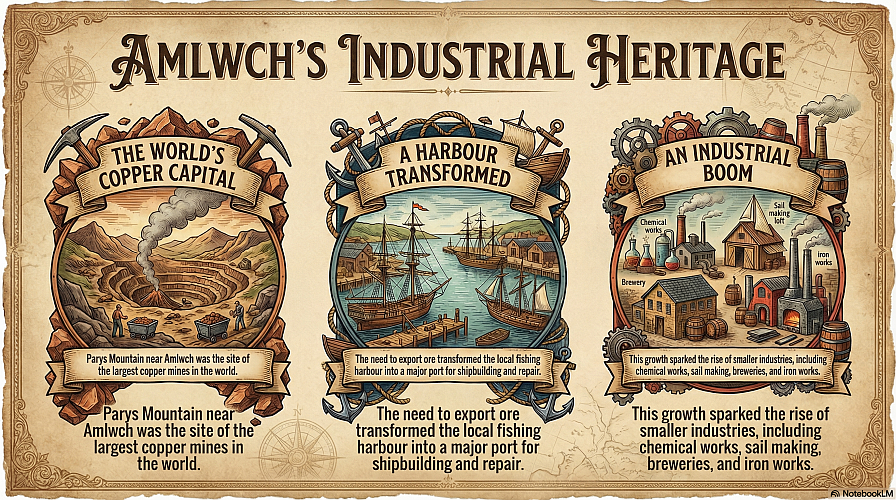
The history of Amlwch in the 20th century is that of industrial might giving way to terminal decline, followed by a slow transition into the modern era. At the dawn of the 1900s, Amlwch was already a town struggling to maintain the momentum of its 18th and 19th-century copper boom. The following story outlines the dramatic shifts in industry and employment that reshaped the town between 1900 and 2000.
The Early 1900s: The Collapse of Victorian Industry
As the new century began, the pillars of Amlwch’s economy—mining, smelting, chemical manufacturing, and milling—began to crumble. In 1899, the Parys and Mona Mine Companies were united in a final attempt to streamline operations, but the venture struggled. By 1892, the workforce had already dwindled to 31 underground workers and 126 on the surface, a shadow of the 1,500 miners employed during the mine’s zenith.
The first decade of the 20th century saw a series of devastating closures:
- The Mona Foundry: This long-standing facility closed its doors in 1902.
- Gwaith Hills (Chemical Works): Under the management of Lewis Hughes, the works had survived for 70 years, producing artificial fertilizers and sulphuric acid. However, facing cash flow problems and a lack of prosperity, the works closed in August 1910. This was a massive blow, as it was described as the town’s “last main employer” .
- Melin Borth (The Windmill): The massive 18-metre windmill, which had been a marvel of mechanical engineering since 1816, ceased working in 1911. Its failure was attributed to financial difficulties caused by cheap foreign grain imports and rising insurance premiums due to the explosive hazard of flour dust.
- Shipping and the Port: By 1910, trade in the port was considered “dead”. In 1913, the Port Trustees surrendered their duties, and the port was purchased by the Urban District Council.
The Death of Copper Mining (1920s)
While there was a brief flourish of trade in 1898 when copper prices rose to £80 a ton, the prosperity was short-lived. A New Paint Works opened at Porth Amlwch during this spike, employing 40 men, but it hardly operated once prices dropped.
The ultimate end of the copper era arrived in 1921 when receivers were called into the mines. This industrial collapse marked the end of the elite “mine agent” class that had dominated Amlwch society for a century. Symbols of this era, such as Mona Lodge, the grand seat of the Fanning Evans family, were put on the market and sold for a mere £1,250 in 1925. By the mid-1920s, the industrial infrastructure of the mountain was largely abandoned.
Mid-20th Century: Post-War Housing and Modern Shifts
Following World War II, the physical landscape of Amlwch’s industrial past was cleared to make way for the future. The ruins of Gwaith Hills were demolished to build the Craig y Don housing estate as part of the post-war building programme. Similarly, Parys Lodge Square, once home to the Dyer mining dynasty, was demolished circa 1961.
In 1954 the Associated Octel company opened in Amlwch port. Hence the link to the chemical industry remained.
At around the same time the modern nuclear power development at Wylfa was being created.
Changes in Employment and Social Structure
Employment in Amlwch underwent a radical transformation between 1900 and 2000. In the late 19th century, census data was dominated by miners, smelters, and agricultural laborers. By 1891, even the most prominent mining engineers, like Thomas Mitchell, were listed as “retired”.
The workforce shifted from the “underground” to a class of Liberal Nonconformist retailers and professionals. Figures like Owen Griffith transitioned from being child miners to chief clerks and eventually retail shop owners and County Councillors.
By the end of the 20th century, the town’s identity moved away from active industry toward heritage and tourism. The ruins of the once-mighty industries became landmarks, such as the Melin Borth tower, which was left standing as a navigational aid for shipping 26. The Dinorben Arms Hotel, which had hosted miners, owners, and even scientists like Michael Faraday, survived as a reminder of the town’s long history.