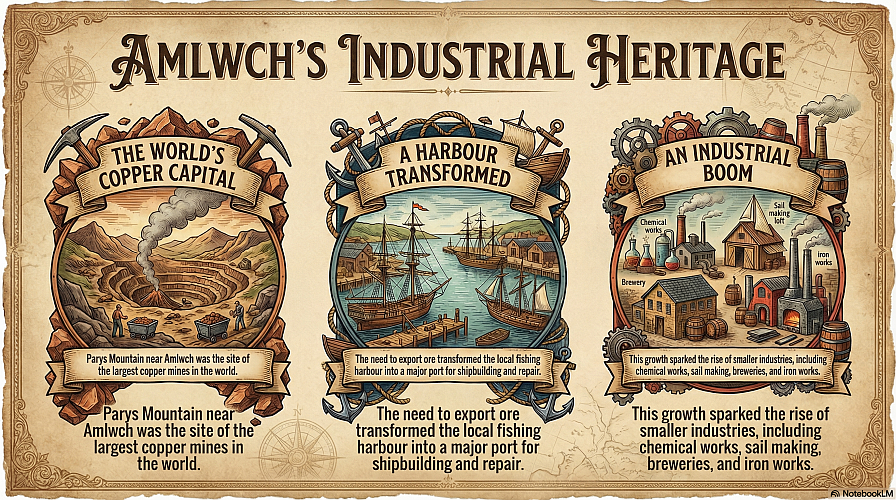

The social history of Amlwch in the 19th century is defined by its rapid transformation from an “inconsiderable hamlet” of fishermen into a populous industrial powerhouse following the discovery of copper at Parys Mountain in 1768. This discovery catalyzed a unique social ecosystem where industrial labor, maritime expertise, and a growing middle class of tradesmen and professionals coexisted within a tightly packed urban environment.
The mining and smelting workforce formed the town’s primary social stratum, with thousands employed in the extraction and processing of ore. Life for these workers was marked by physical danger and rhythmic labor, such as the “reverberated roar” of blasting gunpowder and the precarious sight of miners suspended by ropes over precipices. This community celebrated its identity through unique customs, such as the annual festival on March 2nd commemorating the 1768 discovery, with St. Chad honored as the miners’ patron saint. However, this prosperity was fragile; the “honey-combing” of the mines and subsequent trade depressions between 1800 and 1811 plunged the town into “great distress,” highlighting the community’s total dependence on mineral wealth.
Environmental factors also shaped social life, as the malignant fumes from open-air calcining historically turned hundreds of acres into a barren waste until flues and chambers were introduced in 1784 to condense the sulfurous vapours. This shift not only improved the health of the community but eventually allowed the surrounding land to regain its fertility, supporting the transition of many mining families into small-scale farming by the late 19th century.
The maritime community acted as the vital link between Amlwch’s industrial output and the global market. The census records a sophisticated hierarchy of maritime roles, from the Hobblers (boatmen) who provided manual assistance to leaking vessels in the harbour to the Master Mariners and Pilots who inhabited prestigious areas like Quay Street. The port itself was a center of constant activity, maintaining a fleet of thirty to forty vessels that exported copper, ochre, salt, and corn. Social cohesion was often tested by maritime tragedy; the waters near Point Lynas and Dulas Island were the site of frequent wrecks, such as the loss of the Gipsy King in 1869, which necessitated the deployment of local lifeboats and the bravery of men from Bull Bay and Moelfre.
As the century progressed, a vibrant commercial and professional class emerged to service the growing population. The census documents the proliferation of specialized shops, such as London House and Manchester House, which employed numerous assistants and reflected a desire for urban luxury. Trades ranged from the highly scientific, such as Assay Masters like Evan Thomas who tested ore purity, to specialized manufacturers like John Davies, a snuff manufacturer. The town even supported niche industries like tobacco and alkali works, while diverse professionals like attorneys, physicians, and surgeons established residences on streets like Methuselum and Petter’s.
Intellectual and religious life provided a framework for social advancement and communal support. The establishment of the Literary and Scientific Institution in 1849 under the patronage of the Marquess of Anglesey offered monthly lectures to mechanics and the “influential classes”. Education was anchored by the National school, established in 1821 using the legacy of Mrs. Eleanor Kynnier, which provided gratuitous instruction to hundreds of local children. Religion was equally diverse; while the spacious St. Elaeth’s Church served the established faith, sixteen different Sunday schools were maintained by local dissenters, including Calvinistic Methodists, Baptists, and Independents. This religious fervor often intersected with local history, such as the 1841 discovery of a gigantic skeleton measuring over seven feet long during the digging of ochre pits in the Amlwch area.
However, the 19th century also saw significant social hardship, evidenced by the consistent presence of paupers and the operation of the Union Workhouse. By 1881, the workhouse housed a cross-section of the town’s displaced, including former farmers, laborers, and even specialized workers like a printer’s compositor. Despite these challenges, the people of Amlwch demonstrated resilience, moving between mining, shipbuilding, and agriculture as economic tides shifted. Ultimately, Amlwch’s 19th-century history is a narrative of a community that forged a unique industrial-maritime identity out of the rugged terrain of Anglesey, balancing the immense wealth of the mountain with the perilous realities of a life lived by the sea.