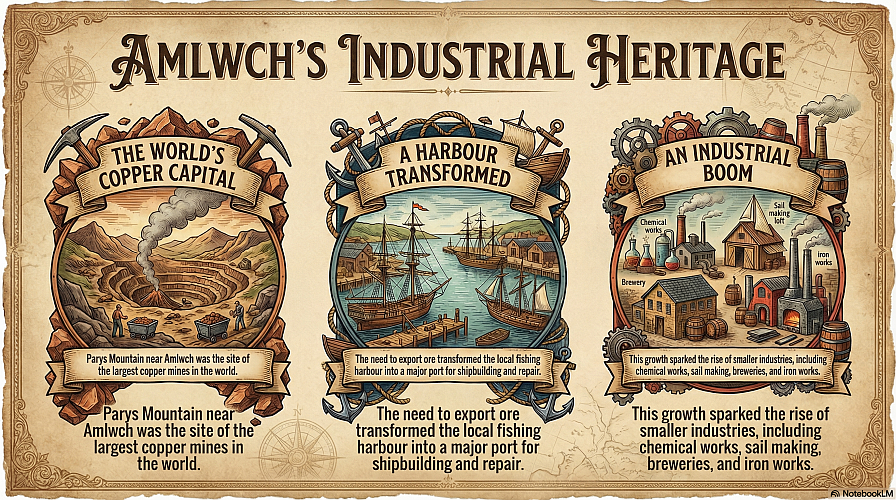

The census records of Amlwch from 1841 to 1891 provide a detailed history of a town that functioned as a robust commercial center, fueled by the mining wealth of Parys Mountain. The commercial landscape was defined by high concentrations of specialized retailers, ranging from general shopkeepers and grocers to luxury drapers, confectioners, and industrial ironmongers.
The Early Era (1841–1851)
In 1841, the town’s retail life was centered around the Market Place, Bridge Street, and Twrcelyn Street. Anne Williams operated as a shopkeeper at 1 Bridge Street, while the Market Place was a hub for higher-end trade, featuring Owen Morris, a Draper, and Griffith Williams, a Druggist. The 1841 census also records Elinor Jones as a prominent shopkeeper on Twrcelyn Street and William Morgans as a major retailer in the Market Place.
By 1851, the industry showed further professionalization. Richard Edmunds was established as a Draper and Grocer in the town, and Ellen Ellis operated a grocery. This period saw the rise of specialized food retailers like Cornelius Jones, a Grocer, and various confectioners like Mary Davies.
Mid-to-Late Century Commercialization (1861–1881)
As the century progressed, shopkeepers began to adopt formal names for their establishments. In 1861, Jane Williams was a prominent widow and Grocer on Chapel Street, while Owen Owens operated a substantial shop in the same area. Well Street emerged as a retail destination with Mary Roberts and her daughters Ann and May all listed as shopkeepers.
The 1881 census provides some of the most specific geographic data for Amlwch’s retail sector. Elizabeth Davies and Martha Williams operated Shop Y Gongl on Market Row, which functioned as a Provision Shop. Nearby was Shop Wrench, a Toy and Provision Shop managed by Catherine Wrench on Market Row. Hugh Hughes ran an eponymous establishment, Shop Hugh Hughes, where he worked as a Draper and Stationer.
In this era, Manchester House on Peters Street became a significant clothing retailer under the management of John Williams, a Master Tailor who employed six men. London House was another major name, with Robert Williams serving as a Linen and Woollen Draper on Methusalem Street, where he employed a large staff of assistants. The town’s industrial needs were met by Richard Williams, who ran an Ironmongery and Tinman shop at Victoria House on Methusalem Street.

The Late 19th Century (1891)
By 1891, the retail landscape had shifted slightly toward Mona Street and Bethesda Street. William Williams (31) managed Anglesey House on Capel Street as a Draper, and Owen Owens (70) ran Eilian House on Llanelian Road, a dual Draper and Grocer business.
Bethesda Street became a dense commercial strip during this time. Catherine Roberts ran a grocery at 33-35 Bethesda Street, while Henry Owen and G. Roberts managed competing grocery shops at numbers 53 and 55. Grace Williams also maintained a grocery at 74 Bethesda Street.
Specialized and Niche Traders
Additionally, the census highlights many small-scale female retailers, such as Jane Jones, a Seed Seller on Tredath, and Catherine Williams, a Sweet Dealer on Queen Street.
Throughout the 19th century, these shopkeepers provided the essential link between Amlwch’s maritime imports—such as coal and “shop goods”—and the local mining community. From the large-scale drapers at London House to the humble Toy Shop on Market Row, these businesses formed the backbone of the town’s social and economic life..