Since 1980, the industrial landscape of the Amlwch area has shifted from heavy chemical production and transport-based industry towards deindustrialisation, heritage, and service-focused uses, with scattered new regeneration efforts. Physical traces of the old copper and chemical eras still dominate the scenery, but their functions and economic roles have changed dramatically.
Decline of heavy industry
From the early 1980s, changing environmental standards and the phasing out of leaded petrol reduced demand for products from the Associated Octel bromine and additives plant on the Amlwch coast. After diversification into other bromine products and several ownership changes, the works finally closed in the early 2000s, with major job losses and the end of regular freight rail traffic to the site in the 1990s.
Transformation of industrial sites
The former chemical works and related rail, storage, and harbour facilities shifted from active production zones to brownfield land, with elements left derelict, reused, or earmarked for future industrial reuse. Local planning documents and historic landscape assessments note that the Octel area and other ex‑industrial parcels are periodically considered for new employment or industrial schemes, though progress has been uneven.
Heritage and tourism emphasis
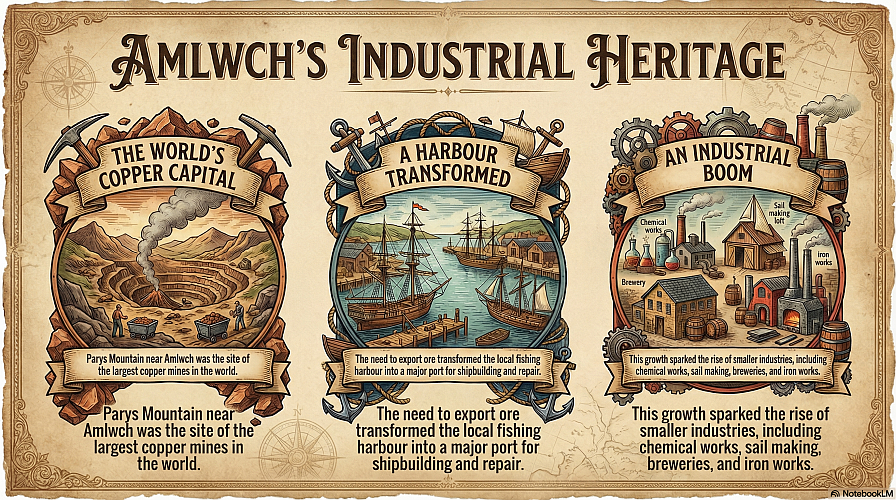
Over the same period, Amlwch’s earlier copper‑mining landscape on Mynydd Parys and around Porth Amlwch has been recast as a heritage resource rather than an active extractive district. Trails, interpretation and conservation work use surviving shafts, spoil tips and harbour structures to attract visitors, embedding industrial relics within a tourism‑driven coastal environment.
Ongoing regeneration context
Since 1980, regional initiatives on Anglesey, including regeneration programmes and the wider “Energy Island” narrative linked to nearby nuclear and energy projects, have framed Amlwch as part of a post‑industrial economy in need of diversification. Policy papers highlight deprivation in the town and promote reusing brownfield land, improving infrastructure, and supporting small enterprises in and around former industrial zones.