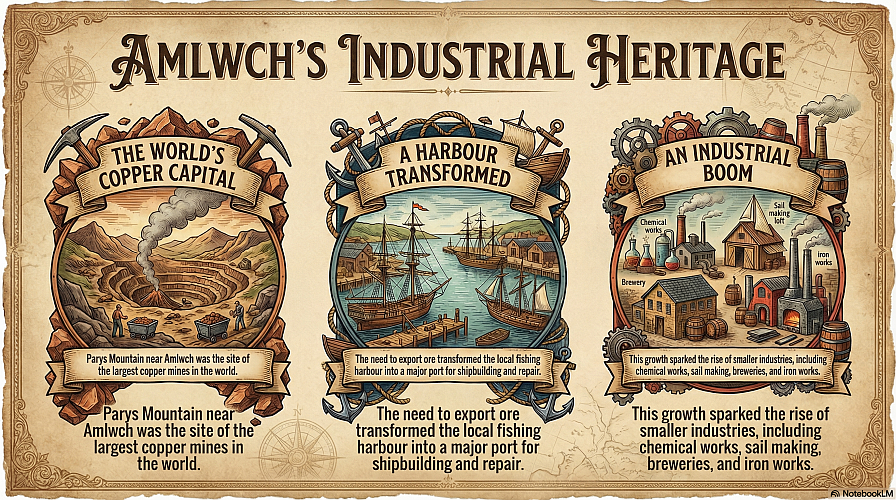
The census records throughout the 19th century document the presence and professionalization of the iron foundry industry in Amlwch, which served as a vital secondary trade to the town’s mining and maritime operations.
The trade evolved from individual craftsmen to organized businesses with designated managers and staff
Leading Ironfounders: In 1851, Richard H. Prichard was identified as an Ironfounder. By 1861, the trade included professionals like Thomas Evans on Chapel Street and George Griffiths on Rosemary Lane, both listed as iron founders.
By 1881, the scale of the industry is clearer, with Heth Jones (55) recorded as an Iron Founder employing six men and two boys.
In 1891, Richard Owen (30) continued the trade as an iron founder at Pont Rhyd Talog
The workforce included various technical roles necessary for metal casting and fitting:
Moulders: This was a common specialized role within the foundry. In 1851, Owen Prichard (18) was a Foundry Moulder. By 1881, Thoms. Stephens (35) was identified as a “Profs Moulder” on Turkey Shore, and 15-year-old Hugh Jones was an iron moulder at Rhos Amlwch.
Foundry Labourers and Workers: General support staff were noted across the decades, such as William Owen (18), a Foundry Labourer in 1851, and John Rowlands (40), who was recorded as working at the iron foundry while living on Upper Quay Street in 1881
The foundry was strategically located to support the copper industry and local infrastructure:
Locations: Workers and professionals associated with the foundry were primarily found in the commercial and industrial heart of the town, specifically Chapel Street, Rosemary Lane, Turkey Shore, and Upper Quay Street.
Intersection with Other Trades: It was not uncommon for foundry workers to hold dual roles; for example, in 1881, Seth Parry was both a Licensed Victualler and a Moulder in the iron foundry at the Druid Arms
An area to the west of the port was developed into an iron foundry where all sorts of materials were made for use in the steam ships that were built in the port. In 1881 Mr Heth Jones was manager of the foundry. Many ornate iron gates and railings were made in the factory as well as parts for the new iron ships being made in the Amlwch ship yards.

Local memory is of a large building with a steel floor. At regular intervals in the floor were square holes. Metal sheets were heated in the furnaces and then place against pegs in the holes of the floor. Large metal wedges where then knocked between the sheets and the pegs, to curve the metal into shapes which had been drawn on the floor in chalk.
The topographical dictionary of 1849 notes that “old iron” was an essential import for the precipitation of copper at the mines, suggesting a deep material link between the iron trade and the dominant copper economy of Parys Mountain