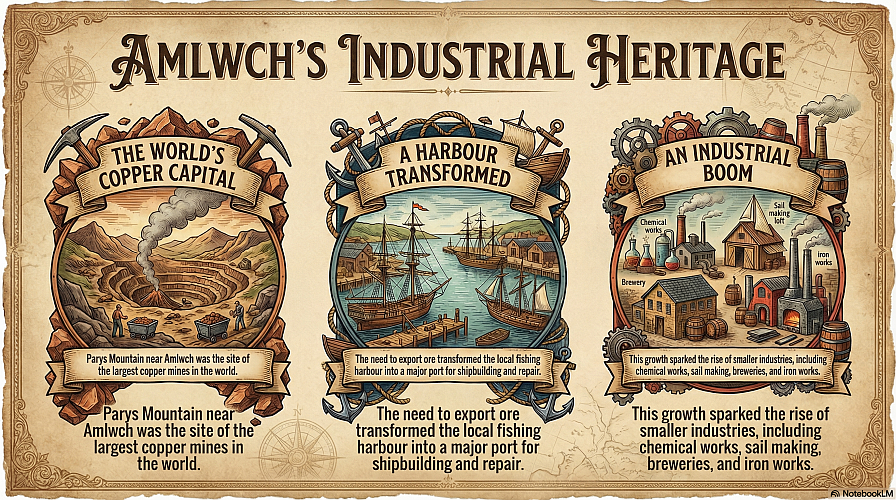
Parys mountain has been mined for Copper since the bronze age period. Large
scale copper mining was abandoned in the later 1890s due to increasing costs.
Since that time a number of companies have continued to explore the possibility of reopening the mine.
Anglesey Mining Company: A Storied Path to Revival
Anglesey Mining plc stands as a UK-based minerals exploration and development firm, primarily focused on its flagship Parys Mountain project in North Wales. Listed on the London Stock Exchange’s AIM market under ticker AYM, the company traces its roots to 1984 and holds significant interests in polymetallic deposits rich in copper, zinc, lead, silver, and gold.
Historical Foundations
Parys Mountain boasts a mining legacy stretching back to the Bronze Age, with evidence of prehistoric underground workings confirmed through carbon dating. It peaked in the 1780s as likely the world’s largest copper mine, producing millions of tons of ore until operations ceased around 1904 amid rising costs. Modern revival efforts began in the 1960s with drilling by firms like Canadian Industrial Oil and Gas, followed by Cominco’s discovery of polymetallic zones in the 1980s. Anglesey Mining formed in 1984 as a subsidiary of Imperial Metals Corporation (Canada), floated publicly in 1988, and sunk a 300-meter shaft with lateral development by 1990, processing 2,000 tonnes of ore in a pilot plant.
Economic downturns halted progress in 1991, shifting focus to care and maintenance, surface drilling, and studies post-1997. The company secured freehold on key western lands in 1997 and holds leases eastward, subject to royalties. Planning permission for a 1,000 tonnes per day mine, granted in 1988 and reviewed in 2006, remains valid.
Parys Mountain remains the crown jewel, a volcanogenic massive sulfide (VMS) deposit with Measured and Indicated resources of 5.3 million tonnes at over 4% combined base metals, plus 10.8 million tonnes Inferred at 2.5%. Recent updates combine zones like White Rock and Engine into Morfa Du, holding 5.72 million tonnes at 2% copper equivalent. Infill drilling and environmental studies advanced in 2021-2023, with the Environmental Impact Assessment Scoping Report approved in January 2025.
As of late 2025, Anglesey issued half-yearly reports, major holdings notifications, and completed warrant offerings to support operations. CEO Robert Marsden, appointed in May 2024, drives Parys advancement amid drilling for copper-rich zones. The site, an SSSI for its geology and biology, enjoys local support and could reach production in under two years with financing.
Challenges persist: metal price volatility, funding needs, and regulatory hurdles for tailings. Yet, with strong resources, permissions, and upside potential from ongoing exploration, Anglesey positions for growth in a tightening minerals market. Directors eye partnerships or asset realizations to unlock Parys’ 160,000 tonnes copper and 400,000 tonnes zinc/lead potential.
In February 2025, Anglesey signed a Memorandum of Understanding (MOU) with RheEnergise, followed by a July 2025 Letter of Intent (LOI) to form a jointly owned special purpose vehicle (SPV). The SPV will fund and manage a feasibility study, deploying RheEnergise’s High-Density Hydro® technology, which uses denser fluid than water for greater energy capacity in shallower shafts.
http://www.angleseymining.co.uk
RheEnergise’s High-Density Hydro® technology enhances traditional pumped hydro storage by replacing water with a proprietary, non-toxic fluid called R-19, which has 2.5 times the density of water. This denser fluid stores more potential energy in less volume and shallower elevations, enabling deployment on hills rather than mountains. Round-trip efficiency matches conventional systems since energy input and output scale linearly with density.
During low-demand periods, excess electricity—often from renewables like wind or solar—powers pumps to lift R-19 from a lower reservoir up a penstock to an elevated upper reservoir or tank. When demand peaks, the fluid flows back down through turbines, generating electricity for the grid. The closed-loop system recycles the fluid continuously, minimizing evaporation and water use.
At Parys Mountain, this integrates with the 300m Morris Shaft: de-watering enables dual-use for mining prep and storage, with fluid hoisting aligning workflows
More information about RheEnergise’s High-Density Hydro