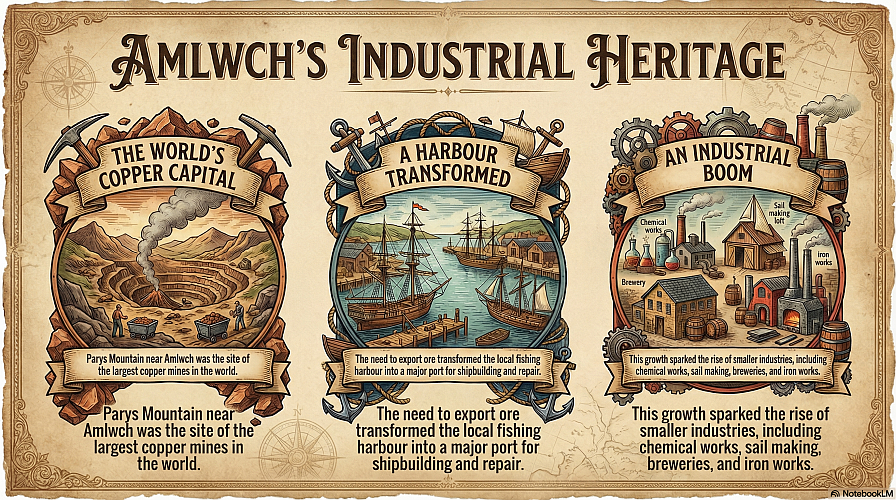
The social and economic landscape of 19th-century Amlwch was dominated by several key “dynasties”—families that provided the professional, managerial, and industrial infrastructure necessary to sustain a town built around the world’s most productive copper mines. These families, often originating from mining districts in Cornwall or commercial hubs like Liverpool, integrated into Anglesey life through medicine, law, shipbuilding, and mine agency.
The Roose Dynasty: Legal, Medical, and Maritime Leaders
The Roose family was arguably the most multi-faceted dynasty in Amlwch, providing the town with its surgeons, attorneys, and shipbuilders for over a century. They occupied central residences on Methuselum Street and at the prestigious Ty Mawr.
- 1801: Mr. Roose is already established at Ty Mawr, while William Roose is recorded at Millbank.
- 1841: The family’s professional reach is evident. George Roose (45) practices as an Attorney on Methuselum Street, living with his daughter Sarah. Nearby, Robert Roose (35) serves as a Surgeon. On School Lane, James Roose (45) is also a Surgeon, living with his wife Alice and children.
- 1851: The family’s influence expands into public office. Samuel Roose (69) is the Supt. Excise Officer, and Stephen Roose (48) is a Magistrate. Charles Roose (43) is established as a Shipbroker.
- 1861: Charles Roose (53) is identified as a Ship Builder, signaling the family’s control over maritime infrastructure. Benjamin Roose (40) serves as a Solicitor at Frondeg.
- 1881: The younger generation remains influential. William Roose (35) is a Public Weigher and his wife Elizabeth is the Matron of the Hospital. Stephen Roose (55) acts as a Farm Bailiff.
- 1891: The family legacy continues with Charles Roose (83) still recorded as a Master Mariner and John Roose (61) practicing as a Chemist.
The Roose family provided the essential “middle-class” services—law and medicine—while simultaneously managing the physical export of copper through their shipbuilding and brokerage interests.
The Treweek Dynasty: The Architects of Mine Management
The Treweeks arrived from Cornwall, specifically Gwennap, to apply deep-mining expertise to Parys Mountain. They were the primary “Mine Agents,” acting as the link between the noble proprietors (the Marquess of Anglesey and Lord Dinorben) and the thousands of local laborers.
- 1841: James Treweek (60) is the principal Mine Agent residing at Mona Lodge. His son, John Henry Treweek (23), is also a Mine Agent on Kings Street.
- 1851: James (71) remains at Mona Lodge, with his place of birth confirmed as Gwennap, Cornwall. William Treweek (28) is an Assayer, responsible for testing ore purity.
- 1861: The family moves heavily into the shipping trade that supported the mines. Nicholas Treweek (56) is recorded as a Shipbuilder at Bod Ednefydd Fawr. William Treweek (38) continues his work as an Assayer.
- 1881: Louisa Treweek (57), born in Oxford, is an annuitant at Parys Lodge Square.
- 1891: Mary Treweek (48) is recorded at 10 Brickpool Street.
The Treweeks were the technical brains of Amlwch. Nicholas Treweek’s shipbuilding yard was responsible for vessels like the Regalia. Their presence brought Cornish industrial innovation to the Anglesey coast.
The Paynter Dynasty: Timber, Law, and Land
The Paynters were essential to the industrial ecosystem, specifically in the supply of timber for mine shafts and ship construction. Over time, they transitioned into prominent legal and landed figures.
- 1841: Anne Paynter (45) is a shopkeeper on Methuselum Street. Thomas Paynter (50) is a Smelter.
- 1851: John Paynter (65) is a Merchant at Maes Llwyn. William Cox Paynter (33) is established as a Timber Merchant, a role vital for mine “baulks” and ship ribs.
- 1861: John Paynter (45) is a Corn Miller at Maes Llwyn. Thomas Paynter (37) follows his father as a Smelter.
- 1881: John Paynter (65) is recorded as a J.P. (Justice of the Peace) for the County of Anglesey, living at Maesllwyn Fawr. John Paynter Jr. (29) is a Solicitor.
- 1891: Jane Paynter (70) is a widow at Maesllwyn.
Through William Cox Paynter, the family provided the raw materials for construction. By the late century, their transition into the magistracy and law solidified their status as local gentry.
The Evans (Mona Lodge) Dynasty: Mining Proprietors
While many Evanses worked as miners, the branch residing at Mona Lodge represented the pinnacle of Amlwch’s industrial administration and political power.
- 1851: Evan Evans (34) is a Clerk, likely training under the Treweeks.
- 1861: Evan Evans (62) has risen to Agent for the Copper Mine and Smelting Works at Mona Lodge. His son Thomas Evans (23) is a Mine Agent and Accountant.
- 1881: Thomas Fanning Evans (43) is now a Magistrate, Mining Engineer, Mining Proprietor, and Ship Owner, living at Mona Lodge. He is one of the town’s wealthiest residents, employing several domestic servants.
- 1891: Thomas Fanning Evans (57) remains the Mine Proprietor at Mona Lodge.
This family provided continuity in mine leadership during the transition from the “honey-combed” depression to scientific underground mining. Thomas Fanning Evans’ role as a ship owner (vessels like the John Williams) linked the family to the town’s maritime risks.
The Williams Dynasty (Commercial): London House and Manchester House
The Williams family (specifically the retail branch) created the town’s commercial heart. They were primarily from Llanerchymedd or Amlwch and established the town’s major drapery and grocery emporiums.
- 1841: William Morgans (70) and Robert Williams (40) are established drapers in the Market Place and Methuselum Street.
- 1851: Richard Edmunds (47) (related to the Williams through marriage/business) is a Draper and Grocer.
- 1881: This year marks the height of their retail empire. Robert Williams (49) runs London House on Methuselum Street as a Linen and Woollen Draper. John Williams (67) runs Manchester House as a Master Tailor. Sophia Williams (34) runs Regent House as a Draper.
- 1891: William Williams (31) manages Anglesey House on Capel Street as a Draper.
These businesses catered to the growing middle class and provided the specialized “shop goods” that were one of the town’s primary imports.
The Jones (Industrial) Dynasty: Tanners and Founders
The Jones family represented the “makers” of the town—those who processed the products of the land and the mountain into finished goods.
- 1841: Owen Jones (35) is a Currier (leather dresser) on Petter’s Street. Hugh Jones (45) is a Snuff Maker.
- 1861: Owen Jones (59) is a Tanner and Currier. Heth Jones (35) is an Iron Moulder.
- 1881: Heth Jones (55) has become a Master Iron Founder employing 6 men and 2 boys. He is the son-in-law of Owen Jones (80), the Retired Corn Merchant.
- 1891: Hugh Jones (49) is a Ships Blockmaker on Brickfield Street.
Heth Jones’ foundry was responsible for the machinery used in the mines and the ironwork for locally built ships. The tanners provided the leather required for mining boots and maritime rigging.
The Matthews Dynasty: Education and Finance
Though a smaller dynasty, the Matthews family provided the intellectual and financial stability required for a modernizing 19th-century town.
- 1851: John Matthews (35), born in Llanddeusant, is a Commission Clerk.
- 1881: John Matthews (42), born in Aberystwyth, is the Bank Manager on Methuselum Street. Simultaneously, another John Matthews (37), born in Llanfaethlu, is the Certificated School Master of the British School, with his wife Ellen serving as the School Mistress.
- 1891: John Matthews (52) continues as the N.P. Bank Manager.
By managing the town’s capital and educating its children, the Matthews family facilitated Amlwch’s move from a crude mining camp to a structured, professionalized society.
Collectively, these dynasties transformed Amlwch. The Treweeks and Evanses managed the subterranean wealth of Parys Mountain; the Rooses and Paynters provided the legal and maritime framework to protect and export that wealth.