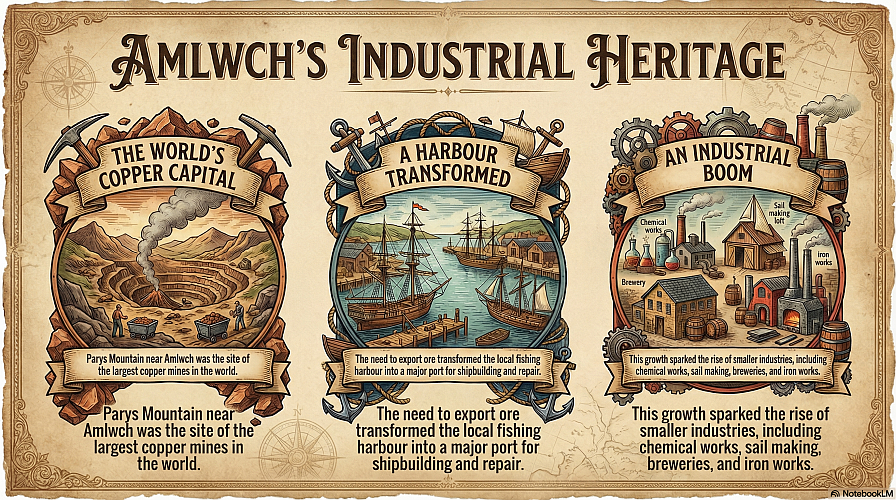

In the history of Amlwch, the presence of alcohol and breweries was intrinsically linked to the town’s meteoric rise as an industrial powerhouse during the 18th and 19th centuries. As the copper mines on Parys Mountain grew to become the largest in the world, they acted as a catalyst for a massive migration of people to the North East tip of Anglesey. This influx of miners, laborers, and tradespeople created a social environment where the consumption of alcohol and the establishment of pubs became a central part of daily life.
Breweries supported the town’s economy, alongside sail making, ship building and the copper mines.. The growth of the port—which evolved from a small fishing harbor into a major site for shipbuilding and repair—further boosted the demand for public houses. Sailors and shipwrights, much like the miners, sought out these establishments for social interaction and relief from their arduous physical labor.
Strange as it may seem today beer houses were actually created by an Act of Parliament which in part was aimed at reducing the amount of public drunkenness. Public drunkenness it was said was in large measure due to a reduction in the duty on gin and the consequent rise in the number of (often unlicensed) gin palaces.
These brash loud establishments so memorably described by Charles Dickens in his Sketches by Boz (published 1835-6) were popularly held to be unbridled dens of immorality and crime and the source of much ill-health and alcoholism among the working classes.
It was a provision within the 1830 Beer Act therefore which brought into being an entirely new tier of drinking establishment – the beer house – which being licensed only for six days a week (i.e. not Sundays) for the sale only of beer and cider (not wine and spirits) was considered by some concerned parties as being of assistance towards helping entice the populace away from its excessive consumption of gin.
Beer it should be remembered was at this time very much an everyday drink – even children drank so called small beer – and it was seen by those agitators among the evangelicals and temperance movements as very much a secondary evil.
Any conviction that the introduction of beer houses might actually lead to a reduction in alcohol consumption however would appear to have been somewhat ill-founded.
During the first year after the 1830 Act came into force more than 240 beer houses opened their doors across the country with by 1835 the figure rising to around 400
Legislation was such that almost any householder on payment of two guineas could apply to the local magistrates for a licence to sell beer on his premises – a situation which led according to W. Howitt in his book The Rural Life of England (published 1840) to early beer houses acquiring the same kind of reputation as the gin palaces before them: “kept by people without capital often without character”.
Topical names for the new beer houses abounded as landlords often dispensed with traditional pub names in an effort to reflect the mood of the times.
Although beer houses became a distinct and well-loved facet of town life the aim of many of their keepers was to upgrade their establishments to the status of a fully licensed public house able to sell not only beer but wines and spirits as well.
As more and more full licences were awarded the number of beer houses began to fall. this can be seen in the Amlwch Trade directories. In 1844 there were 10 Taverns and 14 beer houses listed in Amlwch. In 1883 there were 43 Public houses listed
Historically, Amlwch was famous for the high density of its public houses; at its industrial peak, it was said there was an alehouse for every few dozen residents. Some of the most notable historical pubs included:
• The Dinorben Arms: Often considered the premier hotel and coaching inn of the town, it was a hub for the “Copper Kingdom’s” elite and visiting businessmen.
• The Liverpool Arms: Situated near the port, this establishment catered largely to the maritime community, including sailors and those working in the shipbuilding trade.
• The Market Tavern: Located in the center of the town, serving the “Shops and traders”.
• The Queen’s Head and The Miners’ Arms: These were typical of the smaller venues that catered specifically to the workforce from the Parys Mountain mines.
In 1881, Griffith Edwards managed the Pilot Boat Inn at Bull Bay and was explicitly designated as a “Publican Of Fisherman.
The 19th century census records provides more on the history of breweries, public houses, and the individuals who managed them.
The census records identify a vast array of specific establishments that served as social and commercial hubs:
• Maritime-Themed Inns: Reflecting the town’s port status, these included the Hope & Anchor Tavern (run by Ann Roose), The Skerries Tavern (Mary Owens), Watermans Arms (Mary Williams), Pilot Boat Inn (Griffith Edwards), The Packet House (Hugh Evans), and the New Haven Tavern (Ellen Hughes).
• Civic and Industrial Establishments: Prominent locations included the Liverpool Arms (Owen Jones), The Mona Inn (Elizabeth Hughes), Dinorben Hotel (Ann Roberts), The Railway Tavern (Jane Jones), The George & Dragon (Rice Parry), and the Eagles Inn (Mary Jones).
• Other Establishments: The sources also mention the Harp (Margaret Fisher), Adelphi Vaults (Owen Parry), Royal Oak (Catherine Evans), Sun Pub (Catherine Griffiths), Swan Tavern (Catherine Griffiths), Bulls Head (Ellen Thomas), Castle Hotel (John Hughes), The Stag Inn (Ann Roose), and the Farmers Arms (William Morton).
Brewing was a significant industrial activity in Amlwch, ranging from individual brewers to larger operations:
In 1841, William Hicker was recorded as a brewer at “The Brewery”. By 1881, Thos. P. Williamson was identified as a major brewer on Quay Street, employing seven men.
The workforce included Maltsters (like Thomas Griffiths and James Griffiths), Brewery Workers (like John Owen), and several individuals designated specifically as “Brewers,” including Hugh Evans, Mathew Williams, Richard Williams, David Williams, and Richard Griffiths.
A large portion of the town’s publicans and innkeepers were women, many of whom were widows. For instance, Ann Roose managed multiple establishments over decades, including the Stag Inn and the Hope & Anchor. The Lemin family ran the Odd Fellows Arms (Richard Lemin) and later the Eleth (Jane Lemin).
Database of pubs and breweries in Amlwch in the 19th century.