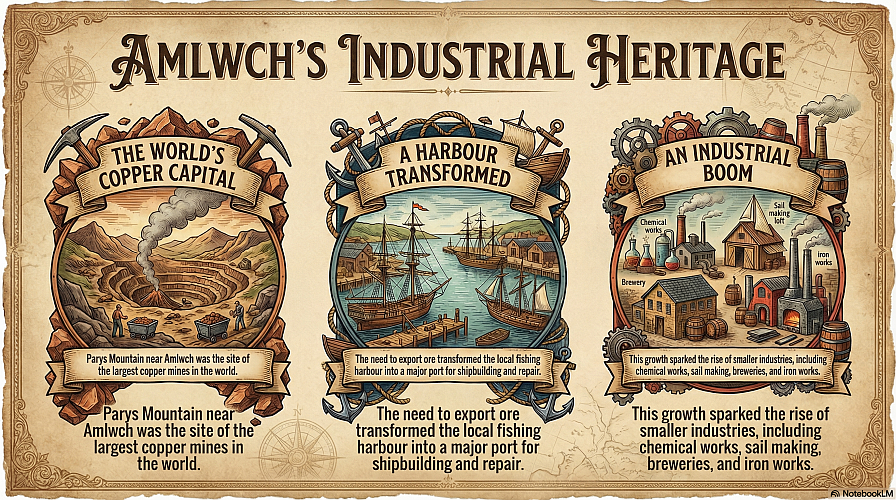

Fueled by Parys Mountain’s copper boom. Sail making emerged as a vital craft, supporting the fleet of schooners and brigs that shipped millions of tons of ore worldwide. Skilled artisans in sail lofts stitched durable canvas to harness North Atlantic winds, embodying the era’s maritime ingenuity amid shipbuilding yards like those of Treweek and William Thomas.
The census records for Amlwch document a steady presence of sailmakers (also recorded as “sail makers”) from 1841 through 1891, highlighting the town’s role as a significant 19th-century maritime and industrial center.
The earliest records show that the trade was established by experienced craftsmen:
1841 Census: Practitioners included John Davies (55) on Twrcelyn Street and James Midson (70) in the Brick fields area.
1851 Census: The trade expanded with younger men entering the profession, including John Ellis (17), Charles Evans (21), and William Evans (17)
By 1861, sailmakers were found in several key residential and commercial locations:
William Morris (42) practiced the trade on Chapel Street.
Morgan Pritchard (56) was identified as a sailmaker in the Rhos area
Later census data shows continued professional activity and the training of new generations:
1881 Census: William Owen (28) was a sailmaker residing at Parys Lodge Square, and Robert Evans (16) was recorded in the trade at 17 Brick Street.
Apprenticeships: The 1881 records specifically identify Rowlan Thomas (18) as a Sail Maker Apprentice living at 20 Peny Bonc.
1891 Census: The trade remained vital with David Williams (56) on Llanelian Road, John Owen (54) on Salem Street, and William Hughes (34) at 15 Ednyfed Hill.
Vessels like the Gaelic (1898) and Cenric (1905), built locally, demanded sails for grueling voyages to Liverpool, Swansea, and beyond. The 1786 Amlwch Shipping Company, managed by mine agents John Price and Stephen Roose, commissioned purpose-built copper carriers, spurring sail production. Lofts repaired storm-torn canvas from wrecks dotting the coast, evolving into full manufacturing as shipyards proliferated.
Workers hand-cut heavy flax or hemp canvas, sewing panels with palm-ironed twine for strength against gales. Patterns for square-rigged sails, fore-and-afts, and jibs were lofted on vast floors, allowing teams to chalk outlines for precision. Iron rings, grommets, and reef points reinforced edges, while tarring preserved fabric from saltwater rot. This labor-intensive process, often family-run, peaked in the 19th century, with 84 pubs quenching shipwrights’ thirst.
Circa 1870, the “Sail Loft” (or “Sail Soft” building) rose overlooking the harbor, a weathered stone relic still standing today. Here, sailmakers mended brigs like the Mary (wrecked 1806) or crafted new suits for steam-schooner hybrids amid the Age of Sail’s twilight. Proximity to copper kilns and widened harbor (1793) integrated sail making into a ecosystem of ancillary trades: ropeworks, blacksmithing, and ochre processing for paints.
By the 1920s, steamships eclipsed sail, idling lofts as copper prices crashed against global competition. Shipbuilding dwindled post-WWI.
Once sail making had finished the building fell into disrepair. In mid 20th Century it was developed as part of the local boat club. Later is was taken over by Amlwch Industrial Heritage Trust and developed into a small maritime museum and cafe.This closed after the pandemic.
In 2026 the building is in the process of being purchased by Amlwch Town council for further development.